
How to Calculate and Pay Provisional Tax in New Zealand
A Practical Guide to Managing Provisional Tax in Hawke’s Bay
Key Takeaways
- Provisional tax is a system for paying your income tax in instalments throughout the year.
- You are required to pay provisional tax if your residual income tax exceeds 5,000 dollars.
- Standard payment dates for a March balance date fall in August, January, and May.
- Planning for the second year of business is essential to avoid a double tax bill.
- Choosing the right calculation method helps align tax payments with your actual cash flow.
If you have recently started a business in Napier or are managing a growing farm in Central Hawke’s Bay, you have likely heard the term provisional tax mentioned with a bit of trepidation. In our experience, much of this anxiety comes from a lack of clarity about what the tax actually represents. Provisional tax is a method of paying your income tax in instalments during the year, rather than facing one large bill at the end. It serves as a way to spread the cost of your tax obligations, helping you maintain a steadier cash flow.
For a wider plain-English overview of New Zealand tax types, see our guide Decoding NZ Tax. We believe that understanding these basics is the first step toward taking the grey areas out of your business finances.

Who needs to pay provisional tax?
The trigger for entering the provisional tax system is based on your Residual Income Tax, or RIT. This is the amount of tax you have to pay after subtracting any credits, such as tax already paid through PAYE or RWT. According to Inland Revenue, you must pay provisional tax if your residual income tax from your last return is more than 5,000 dollars. This threshold was increased from 2,500 dollars to 5,000 dollars in 2020 as a response to the economic climate, providing more breathing room for smaller operators and contractors.
Once you cross this 5,000 dollar mark, provisional tax becomes payable in the following tax year. We often see local contractors or rental property owners surprised by this transition. While our own provisional tax facts page notes the historical 2,500 dollar threshold, we always ensure our clients are working with the most current IRD rules to keep their planning accurate. If your side-hustle or small business grows to the point where your year-end tax bill exceeds that 5,000 dollar limit, you have officially entered the provisional tax territory.
How is provisional tax calculated?
There are several ways to work out how much you should pay. The best method for your business depends on how predictable your income is and how much time you want to spend on administration. We typically walk our clients through three main options.
The Standard Method is the default choice for many. Under this method, your provisional tax is calculated as your previous year’s residual income tax plus a 5 percent uplift. If you have not yet filed your latest return, the calculation uses the prior year’s RIT plus a 10 percent uplift. This provides a predictable figure for the year ahead. As noted by TMNZ, this method is straightforward and helps most 31 March balance-date taxpayers split their total liability into three equal instalments.
The Estimation Method allows you to predict what your income will be for the coming year. This is useful if you expect your profit to drop significantly. However, we advise caution here. If you underestimate your income and pay too little tax, you may be charged use-of-money interest by the IRD. We have seen this happen when businesses experience an unexpected late-year surge in sales.
The GST Ratio Method and the Accounting Income Method, or AIM, are also available for eligible businesses. These methods align your tax payments directly with your actual turnover or profit as recorded in your accounting software. These options are excellent for businesses with seasonal income, such as those in the Hawke’s Bay horticultural sector, as they ensure you only pay tax when you are actually earning money.
Key dates at a glance
For the vast majority of Hawke’s Bay businesses, the tax year ends on 31 March. If you are using the standard or estimation methods, your payments are generally due in three instalments. According to the Xero 2026 guide, the key dates for a 31 March balance date are 28 August, 15 January, and 7 May.
Missing these dates can be costly. The IRD applies late-payment penalties, starting with a 1 percent penalty on the first day the payment is late, followed by a 4 percent penalty on the seventh day. Furthermore, MoneyHub highlights that unpaid amounts can attract use-of-money interest, which is currently around 8.97 percent per annum. Keeping these dates in your calendar is a simple way to avoid unnecessary expenses.
Why Year Two hurts if you do not plan
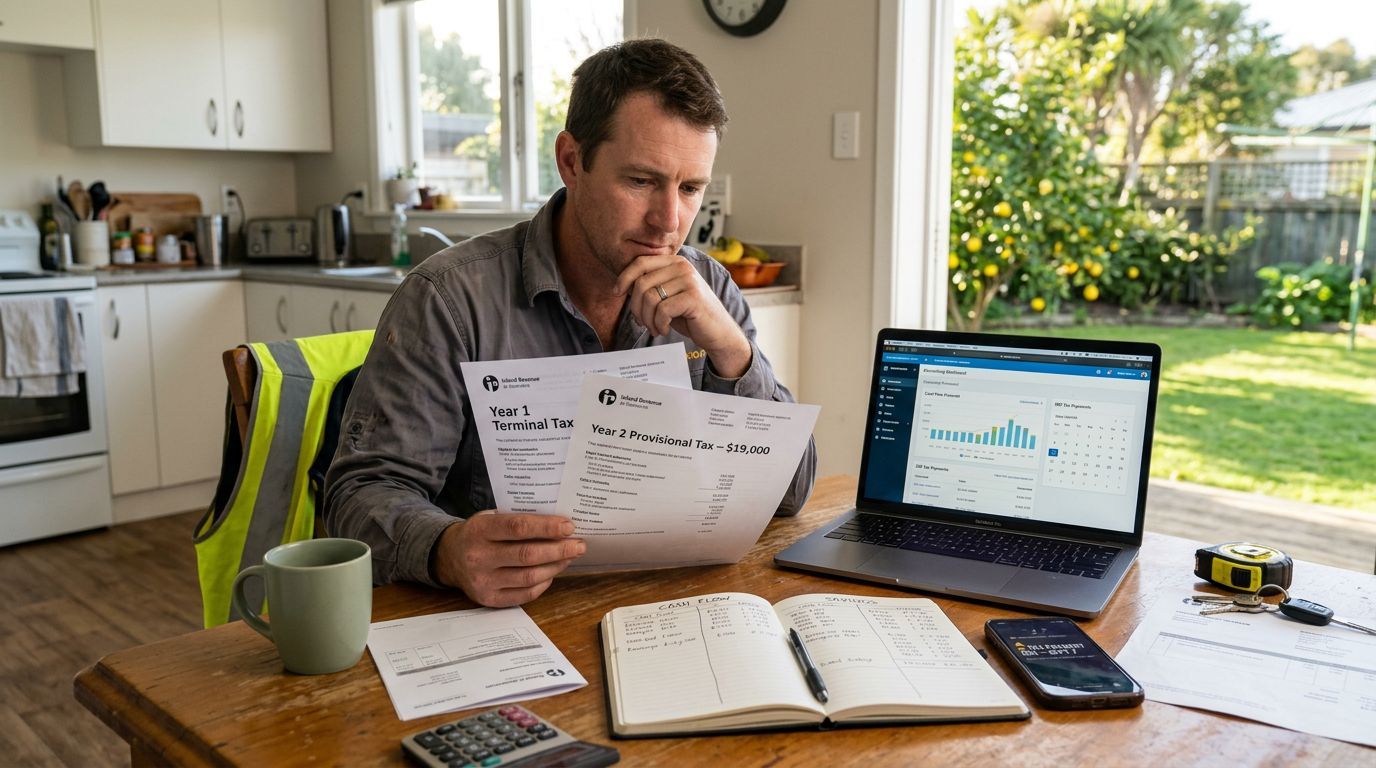
A common mistake we observe is the failure to prepare for the second year of business. In your first year of trading, you generally do not pay tax as you go because you have no previous year’s RIT to trigger the provisional tax requirement. This creates a situation where you owe a lump sum for Year 1, known as terminal tax, at the same time you start paying provisional instalments for Year 2.
Consider a contractor in Hastings earning 80,000 dollars. In their second year, they could face a terminal tax bill of approximately 18,000 dollars for their first year of work. Simultaneously, they must begin paying roughly 19,000 dollars in provisional tax for the current year. This results in a total tax outgoing of 37,000 dollars within a single 12-month period. This Year 2 tax crunch is a significant cash flow hurdle that requires early forecasting and disciplined saving.
Managing your cash flow with confidence
We believe that tax should be a manageable part of your business, not a source of constant stress. Managing your cash flow involves more than just knowing the dates. It requires a proactive look at your business performance throughout the year. We often use management accounting and strategic planning to help our clients see what is coming over the horizon.
If you are worried about an upcoming tax bill, there are ways to structure your finances to handle the load. This might involve setting up a dedicated tax savings account or looking at lending and finance options to smooth out your payments. Our goal is to provide straight-up solutions that keep your business moving forward without the shock of an unexpected IRD notice.
Taking the next step
Provisional tax is a sign that your business is succeeding and reaching a level of sustainable profit. While the rules can seem complex, they are designed to prevent you from falling behind on your obligations. We are here to tell it like it is and help you choose the calculation method that best fits your specific situation.
We offer a free initial consultation to discuss your business needs and how we can help you stay ahead of the IRD. Whether you need help forecasting your tax, selecting the right payment method, or building a comprehensive cash flow plan, our team provides tailored support for individuals, small businesses, and farms across the region. You can learn more about our full range of taxation and accounting services on our website. Let us take the grey areas out of your tax so you can focus on running your business.
Disclaimer: This article provides general information only and does not constitute formal financial or tax advice. Tax laws and interest rates are subject to change. We recommend consulting with a professional accountant to discuss your specific circumstances before making any tax-related decisions.